BirdUp · Species
Little Friarbird
Philemon citreogularis(Gould, 1837)
Updated
- Order
- PASSERIFORMES
- Family
- Meliphagidae
- Genus
- Philemon
At a glance
The Little Friarbird is a medium-sized bird, about 25–29 cm long, listed as Least Concern and native to Australia. It can be seen year-round.
- Size
- 25–29 cm
- Conservation status
- Least Concern
- Origin
- Native
- Best seen
- Year-round
- Commonness
- Very common
- Movement
- Partial migrant
01 · Identification
How to tell it apart
What does a Little Friarbird look like?
The Little Friarbird is a medium-sized bird, about 25–29 cm long and weighing 46–84 g, identified by its smooth bill profile, no casque; distinct pale yellow throat patch; bare blue-grey skin on face; and silky white plumes on sides of nape.
The Little Friarbird is the smallest of Australia’s friarbirds, measuring 25 to 29 cm. Its primary diagnostic feature is the complete absence of a raised knob at the base of the black bill, a trait that distinguishes it from all other Australian friarbirds. It features a patch of bare, dark bluish-grey skin extending from the eye to the bill, but unlike its larger relatives, it retains fine brownish-grey feathers across the rest of the head. The upperparts are a uniform olive-brown, while the underparts are a pale greyish-white with a distinct silvery wash or fine streaking across the throat and upper breast. Juveniles are easily identified by a pale yellow wash on the chin and throat. Highly vocal and gregarious, this honeyeater produces a variety of loud, raucous calls, including a metallic "rackety-chack" or a rhythmic "choo-wick." It is an active and often aggressive species, frequently chasing smaller birds away from flowering trees. An acrobatic forager, it is often seen hanging upside down to probe blossoms for nectar or gleaning insects from the canopy. Its flight is strong and conspicuously undulating. Widespread across northern and eastern Australia, the Little Friarbird occupies diverse habitats including tropical savannas, dry sclerophyll forests, mangroves, and suburban gardens. While northern populations are generally resident, southern birds are migratory, moving north during the winter. To distinguish it from the Noisy Friarbird, look for its smaller size and feathered crown; the Noisy Friarbird possesses a completely bare, black leathery head and a prominent bill knob. The similar Silver-crowned and Helmeted Friarbirds also possess bill knobs and distinctive plumage features, such as the Silver-crowned’s namesake cap.
Description · BirdUp · CC BY-SA 4.0
- 01
Smooth bill profile, no casque
Immediately separates it from other friarbirds. Lacks the prominent knob or casque on the upper bill.
- 02
Distinct pale yellow throat patch
A small but noticeable patch of pale yellow feathers visible on the lower throat, contrasting with the grey body.
- 03
Bare blue-grey skin on face
The bare skin extends from the lores to around the eye, contrasting with the head plumage.
- 04
Silky white plumes on sides of nape
Small, upward-curving tufts of silky white feathers, subtle but visible from the side or behind.
03 · When
When to look
When can you see a Little Friarbird?
The Little Friarbird is present across its Australian range year-round, so it can be seen in any month.
- Jan
- Feb
- Mar
- Apr
- May
- Jun
- Jul
- Aug
- Sep
- Oct
- Nov
- Dec
04 · Voice
What it sounds like
What sound does a Little Friarbird make?
Recordings of the Little Friarbird on BirdUp feature its begging.
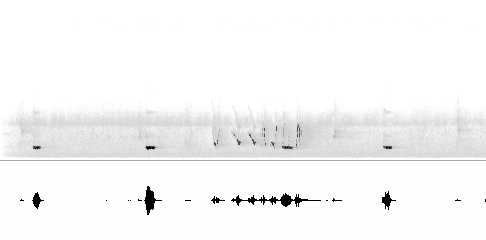
begging · Quality B
Rob Nicholson · Greenup Meeting Place, 40 Greenup Limevale Rd, Coolmunda, Queensland, Australia
Call
Tanya Zubakin · Clarence Valley Bal, AU-NS, AU
Call
Bethlea Bell · Bouldercombe QLD 4702, Australia
Call
Jonathan Mills-Anderson · Brisbane QLD, Australia
05 · Behaviour
Habits and haunts
What does a Little Friarbird eat?
The Little Friarbird feeds on fruit, nectar/pollen, seeds and terrestrial invertebrates, usually foraging in pairs or flocks or alone.
06 · Gallery
Plumage up close
6 photos
The BirdUp app
Log your next Little Friarbird in the field
A pocket field journal for 850+ Australian birds. Offline-first, smart ID, and a lifelist that travels with you.